

The Blog

The Top Ways Brands Can Use Amazon SEO to Increase their Product Visibility and Conversion Rates
An amazon seller’s guide to utilizing keywords, amazon a+ content, and best sellers rank to organically appear at the top of search engine results pages on amazon and google
Amazon search engine optimization (SEO) is the ultimate hack for brands to drive traffic, gain product visibility, and increase conversion rates. Amazon’s A9 Algorithm favors products with the most sales. Thus, more conversions equal more visibility. Brands that optimize their product listings for Amazon SEO tap into a cycle that keeps giving.
Amazon SEO
“Amazon SEO is the process of optimizing product listings to help them rank higher in product searches on Amazon.com,” says Amazon. “Keywords are the words and phrases people look for when searching for something online.”
Powerful Amazon SEO is like a GPS — keywords and phrases are the routes that lead shoppers to their destination, the product page. Any brand can use SEO to rank organically on Amazon’s search engine results page (SERP), making this marketing tactic one of the most accessible. Business growth and consistent sales are crucial to Amazon brands. With SEO, they can easily have both.
Amazon’s A9 Algorithm
Each search engine platform like TikTok, YouTube, Google, and Amazon has its own algorithm that helps organize search results. Algorithms provide searchers precisely what they want as quickly as possible based on the SEO keywords entered into the search bar.
Where Amazon’s A9 algorithm differs from other search engine platforms is its favoritism of sales conversions. The algorithm prioritizes products with long sales history and high conversion rates. When consumers search for a product, Amazon’s A9 search algorithm will display search-related best-selling products highest on the SERP.
How Amazon and Google SERPs Work Together for Product Visibility
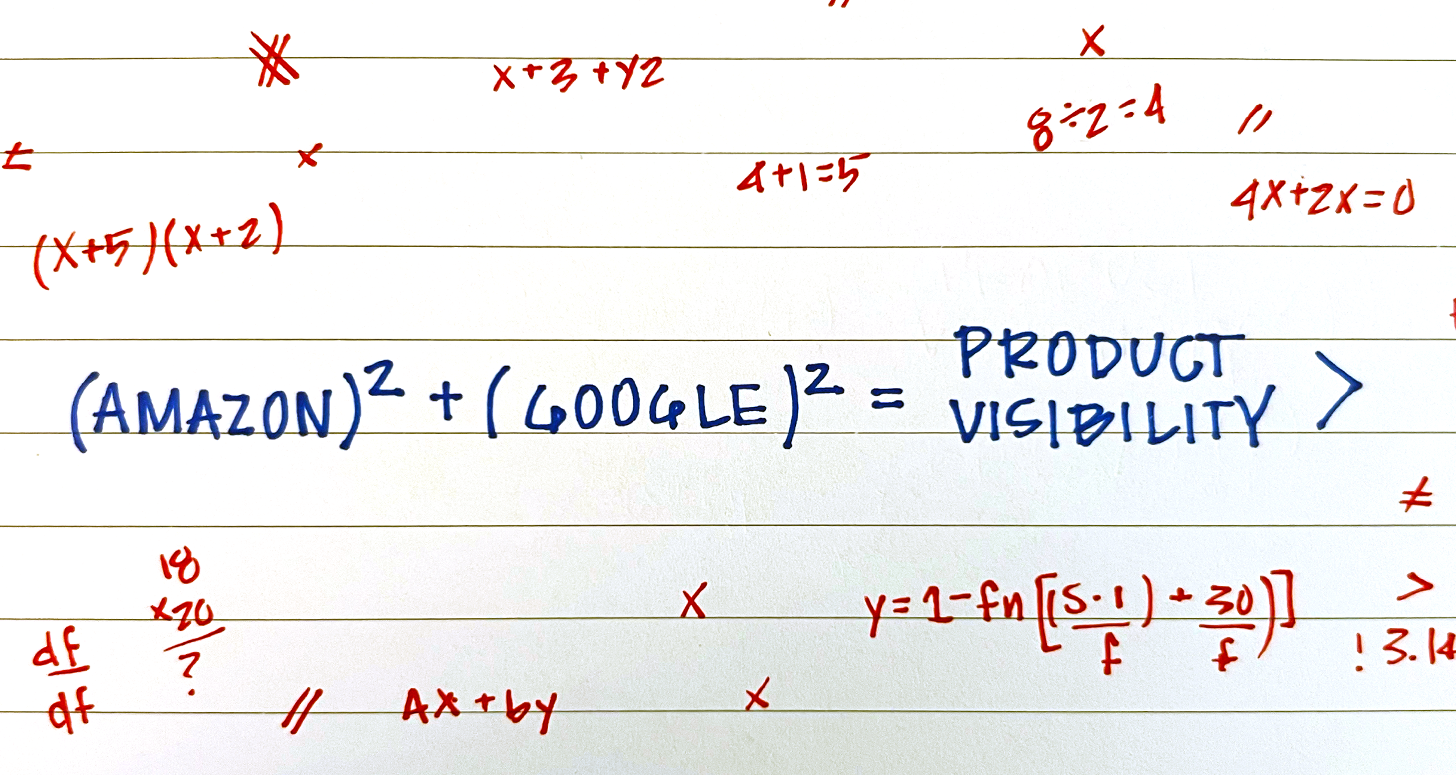
Every opportunity for text on Amazon is also an opportunity to rank on Google. When a brand lists a product on Amazon, Google also indexes it — strategic copy can increase a product page’s visibility and ranking on both SERPs. Since most shoppers also use Google to find products, brands must remember that keyword-heavy product pages equal more visibility on Google, resulting in a higher conversion rate.
Optimizing Product Listings with Keywords and Phrases
Keywords are a combination of words and phrases related to a product that shoppers search for on Amazon. These can include long-tail and short-tail keywords. Long-tail keywords are precise and contain multiple terms related to a particular brand’s product. Short-tail keywords are broader and can relate to many brands’ products in a category. A sock company selling its products on Amazon would want to use both types of keywords like “ankle socks” and “blue organic cotton ankle socks for women.”
Brands can also use backend keywords to boost visibility and conversions. Sellers can add backend keywords to the “search terms” box in each product listing when editing an item. These terms are not visible to buyers but serve as an additional space to place related terms or acronyms related to the product.
Amazon Keyword Research
When using Amazon as a research tool, brands can discover which related keywords generate most frequently for their product category. Helpful questions all brands should address when doing Amazon keyword research include:
- Which keywords best describe the product?
- What phrases will shoppers search to find the product?
- What questions will shoppers have about the product?
Brands should strategically utilize each text component of product listings for SEO. When indexing, Amazon’s search engine heavily considers product titles, details, and descriptions.
Amazon Keyword Guidelines
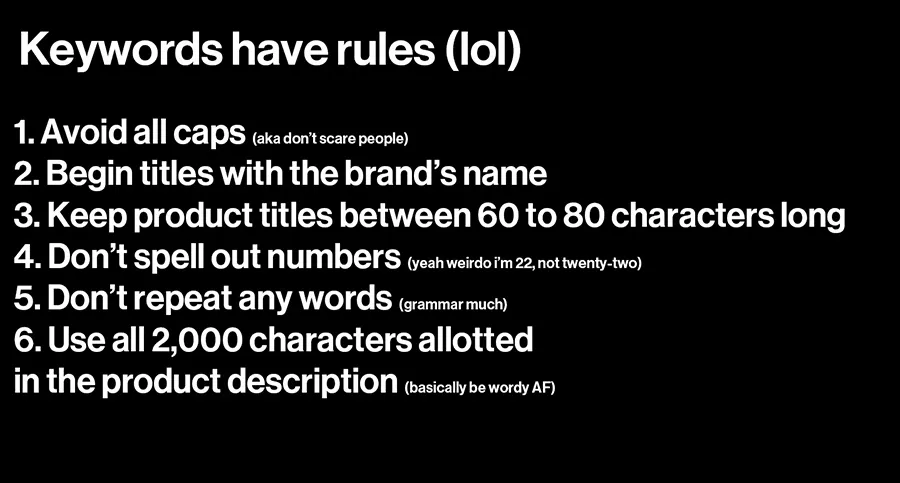
Although fitting as many keywords as possible into product titles may be tempting, brands must maintain clarity and readability. In addition to Amazon’s product listing guidelines, the following recommendations will enhance SEO efforts:
- Avoid all caps
- Begin titles with the brand’s name
- Keep product titles between 60 to 80 characters long
- Don’t spell out numbers
- Don’t repeat any words
- Use all 2,000 characters allotted in the product description
Optimize Product Listings with Amazon A+ Content
Amazon A+ Content works hand-in-hand with keywords and phrases to boost a product listing’s ranking on Amazon’s SERP. Brands enlisted in Amazon Brand Registry can utilize the Amazon A+ Content to add dynamic professional product photography, videography, and graphics to product and storefront pages. Content can include banner images, product features, and text.
Amazon’s A9 algorithm favors product listings with Amazon A+ Content that complies with established guidelines and terms of service. The following policies will help brands optimize their product pages for a high ranking on Amazon’s SERP:
- Image resolution should be at least 72 DPI but remain under two MB
- Animated images are not allowed
- Files must be JPEG, BMP, or PNG
- Images should be RGB, not CYMK
- All graphic text must be large enough to read on mobile devices
- All images must load properly in Amazon’s preview function
Utilize Amazon Best Sellers Rank to Optimize Product Pages
Amazon Best Sellers Rank (BSR) significantly affects how Amazon’s A9 algorithm ranks product pages. Unlike other components of Amazon SEO, BSR calculates the ranking of a product compared to others in the same product category. Brands that rank number one in a category with at least one hundred products receive the Best Seller Badge, the ultimate win for an Amazon brand’s SEO. Factors that contribute to a BSR badge include account health and product pricing.
Account Health
Amazon determines account health by a seller’s adherence to Amazon’s terms of service and regulations for product listings. Brands with excellent account health have optimized product listings. Factors include preventing late dispatches, order defects, and cancellations. Brands must ensure customers are consistently fulfilled and happy with their products.
Product Pricing
Pricing is superior for leveraging any optimizing strategy. An inaccurately priced product will not sell, no matter how optimized the product page is. Amazon’s automated pricing tool helps sellers adjust prices to represent trends accurately.

How to Improve Amazon Product Photography for Increased Sales
A guide to optimizing product photography for a high-performing amazon storefront including an amazon a+ content breakdown and photo guidelines
A crisp, attractive photo can be the deciding factor for a shopper scrolling through Amazon’s product search page. Product photography is a component of e-commerce marketing where brands take pictures of their products with the intent of using them to drive sales. When searching for a product, there are millions of competing listings — product photos being the only differentiating visual factor. Amazon brands can easily one-up their competition by optimizing product photography across storefronts and product pages.
Product Photography Crash Course

The key to a stellar Amazon product listing is professional product photography. Product photos draw shoppers in and tell them precisely what the product is, motivating them to buy. Shoppers will have difficulty deciphering a product’s quality without good lighting, a crisp white background, and professional equipment. Thus, scrolling right past.
Adequate lighting can come from expensive lightboxes or even a large window. Regardless, it should be bright enough to illuminate the product but not too oversaturated that it leaves a white cast.
A cyclorama, or cyc wall, can create a crisp, seamless background for cohesive product photos. This feature is usually a white-walled installation with curved edges and seamless corners.
Filming equipment can consist of cameras, tripods, or any item that may assist in getting a good shot. Although professional digital single-lens reflex (DSLR) cameras are popular among Amazon brands, beginners can shoot incredible footage with smartphones.
Shooting and editing product photos can be overwhelming. Amazon brands will find hiring a creative studio with its own cyc wall and production services a worthwhile investment. POLA Studio allows for experimentation without losing quality or uniformity.
Using Product Photography to Optimize Product and Storefront Pages

Once an Amazon brand has impeccable product photography, it’s time to put it to good use. Product photos enable shoppers to view the product from various angles or different colors and can persuade them to click on one search result over another.
According to Amazon, “Effective product images stimulate a customer’s imagination and inspire them to make a purchase.”
While shoppers go to Amazon’s search page first to find a product, they visit storefronts to discover the brand and its offerings. Product photography significantly affects how shoppers interact with storefront pages. Amazon brands can add pages with different layouts to their storefront to create an engaging and informative experience for shoppers.
Amazon storefront layouts include:
- A product grid that displays products only
- A marquee that displays products, imagery, descriptions, and customer quotes
- A showcase for a broad selection of products, information, and visual content
Product and storefront pages with compelling, high-quality product photography can help boost rankings on Amazon’s search engine results page (SERP). Since most shoppers also use Google to find products, brands must remember that high-ranking product pages equal more sales.
Amazon A+ Content Breakdown
The limited space on most Amazon brands’ product and storefront pages isn’t enough to convince shoppers to buy. Through Amazon Brand Registry, businesses can utilize Amazon A+ Content to display more photos and dynamic content on product and storefront pages. Amazon A+ Content modules consist of over a hundred image and product field combinations, allowing brands to find the optimal fit.
Amazon A+ Content has been proven to incite brand recognition and customer trust. According to Amazon, a product’s conversion rate increases when sellers use and optimize Amazon A+ Content.
Amazon Product Photo Guidelines Explained

For any product photography strategy to be beneficial, brands must comply with Amazon’s terms of service. Guidelines differ for each photo placement — brands should be familiar with all of them to remain in adherence.
General Image Guidelines
All images must be at least 500 by 500 pixels. Brands can increase the size to 1,000 by 1,000 pixels for higher quality. All product images must have a basic white background. Any product featured should fill at least 85 percent of the photo.
Main Photo Guidelines
The main photo is the first image appearing on a product listing, making it the first impression shoppers will have. Main photos must follow the general image guidelines and also adhere to the following main photo rules from Amazon:
- Illustrations, graphics, placeholders, or mockups are not allowed
- Product photos can not include accessories or props not sold with the product
- Text, logos, borders, or watermarks are not allowed
- The image can not display various views of the product
- The entire product must be shown in the main image
- Packaging should not be pictured
- All multi-pack apparel items must be photographed flat
- Mannequins should not be used in main photos
- Women’s and men’s clothing should be shown on a human model
- Children’s and baby clothing must be photographed flat
- Shoes should be photographed singularly, facing left at a 45-degree angle
Amazon A+ Content Photo Guidelines
Amazon A+ Content works hand-in-hand with keywords and phrases to boost a product listing’s ranking on Amazon’s SERP. Brands enlisted in Amazon Brand Registry can utilize the Amazon A+ Content to add dynamic professional product photography, videography, and graphics to product and storefront pages. Content can include banner images, product features, and text.
Amazon’s A9 algorithm favors product listings with Amazon A+ Content that complies with established guidelines and terms of service. The following policies will help brands optimize their product pages for a high ranking on Amazon’s SERP:
- Image resolution should be at least 72 DPI but remain under two MB
- Animated images are not allowed
- Files must be JPEG, BMP, or PNG
- Images should be RGB, not CYMK
- All graphic text must be large enough to read on mobile devices
- All images must load properly in Amazon’s preview function

Reasons Why Brands Should Utilize a Creative Studio for their Amazon Storefronts
A guide for amazon brands looking to utilize a creative studio to gain optimized product pages and storefronts
Branding, product photography and videography, ad graphics, and optimized product copy play an equally important role in the growth of e-commerce stores. On Amazon, visual and verbal content appears across product pages, storefronts, and advertisements. To generate consistent sales, brands must curate all brand-related content with diligence. For this reason, Amazon brands should never underestimate the power of working with a creative studio. Brands can say goodbye to the hassle of producing product content and can focus on business growth.
Branding
Unlike e-commerce businesses with elaborate Shopify websites, Amazon brands have limited space for branding on their storefronts. A daring visual identity optimized just for Amazon brands will stand out among competitors more than most realize.
According to SellerApp, “By developing your brand, you have the upper hand on Amazon and will shoot to the top five slots relatively fast compared to your competition.”
Consistency is the backbone of effective branding, especially on Amazon. The human mind favors frequency and familiarity. Correspondingly, shoppers will trust brands with cohesive, recognizable branding that communicates their shopping needs. A creative studio can streamline all branding elements into a cohesive identity that will entice shoppers to purchase.
Product Photography and Videography

Photo Credit: POLA Studio
Customers are likelier to purchase products showcased through professional, high-quality photography and videography. When shoppers are faced with the decision between a product with a blurry photo or a bright, clear visual, they’re likelier to choose the latter.
Most Amazon customers prefer to look at photos or watch videos for product information. Filming with professional equipment, good lighting, crisp sound quality, and clean backgrounds immediately elevates products above competitors.
Capturing photos and videos with proper lighting and backdrops can become quite pricey. Instead of expending energy learning to accomplish promising results, brands can hire a creative studio. All the equipment brands need to achieve the most polished product photography, and videography is always available. Plus, creative studios offer packages that include shooting and editing all product photos.
Some studios, like POLA Studio, have exclusive features like a cyclorama, also called a cyc wall. This feature is usually a white-walled installation with curved edges and seamless corners. For Amazon brands, a cyc wall can create a crisp, seamless background for cohesive product photos.
For Amazon audio ads, brands may seek a creative studio with professional recording tools like microphones, windscreens, and noise-canceling headphones.
Amazon Advertising
When building digital ads, graphics must grab the attention of scrollers to enhance performance and create lead generation. Potential clients will scroll right past uninteresting, low-quality, or confusing content. Whether brands sponsor a product page, brand page, or display ad, all graphics must be specially curated. Following the branding guideline across all graphic content is advisable when starting the design process.
On top of meeting Amazon’s requirements, brands should follow standard design etiquette for all ad infographics and visual content. Some basic design guidelines include the following:
- Ensuring all text is aligned
- Avoiding the use of more than three different font types
- Leaving some negative space for visual clarity
- Adhering to branding guidelines for the color palette, fonts, and other graphic elements
Creating graphics for Amazon advertising can be overwhelming for brands juggling business operations. A creative studio will formulate the best quality graphics and ensure each deliverable complies with Amazon’s guidelines and design etiquette.
Repurpose Content for Social Media
High-quality content can be repurposed across all social media platforms, thus increasing return on investment (ROI) when working with a creative studio. Amazon brands can utilize product photos for ads on Pinterest or organic posts on Instagram. Informational product videos make great TikTok posts. The versatility of working with a creative studio allows Amazon brands to outshine their competition efficiently.
Pintrest Ads

Photo Credit: POLA Studio
Pinterest is a social media platform that allows users to search for inspiration, ideas, and products. Users can create boards to save products to shop for later — similar to a wishlist or vision board. Most Pinterest users utilize the platform to make buying decisions. For Amazon brands, Pinterest ads place products in front of audiences already willing to purchase.
Organgic Instagram Posts
Another social media platform Amazon brands can take advantage of is Instagram. As a more visually-focused space, Instagram can help build brand awareness organically. Amazon shoppers go to Instagram for a closer look at what brands are doing and how others use their products.
TikTok
On TikTok, short-form vertical videos take the spotlight. Amazon brands can utilize the casual environment of the platform to their advantage. With a plethora of repurposed video content from a creative studio, brands can post for several weeks. TikTok is popular among all age ranges, making it the perfect avenue for brands to communicate with hard-to-reach audiences.