

The Blog

How Death Wish Coffee Company Disrupted the Coffee Industry Through Marketing and Branding
In a saturated market, death wish coffee company’s rebellious marketing strategy and bold blends keep it alive and growing
Jittery hands and hyper brains run the live wire that is Death Wish Coffee Company. With a rebellious nature and nurturing spirit, Death Wish Coffee supplies dreamers and doers with the world’s strongest cup of coffee. After all, those following their own path must have a death wish.
At its core, Death Wish Coffee is a direct-to-consumer (DTC) brand that focuses on selling coffee online and through retailers like Walmart, Target, and Whole Foods. Where Death Wish Coffee differs from other brands is its blend of organic and fair trade certified Arabica and Robusta beans. One cup of Death Wish Coffee has twice the caffeine of a regular cup — a caffeine kick with a punch.
A harmonious medley of marketing trends and good timing usually steer companies to success. While this is true for Death Wish Coffee, ample opportunities and disruptive marketing gave it the jolt it needed to brew great things.
The Man Who Brewed the Strongest Cup of Coffee
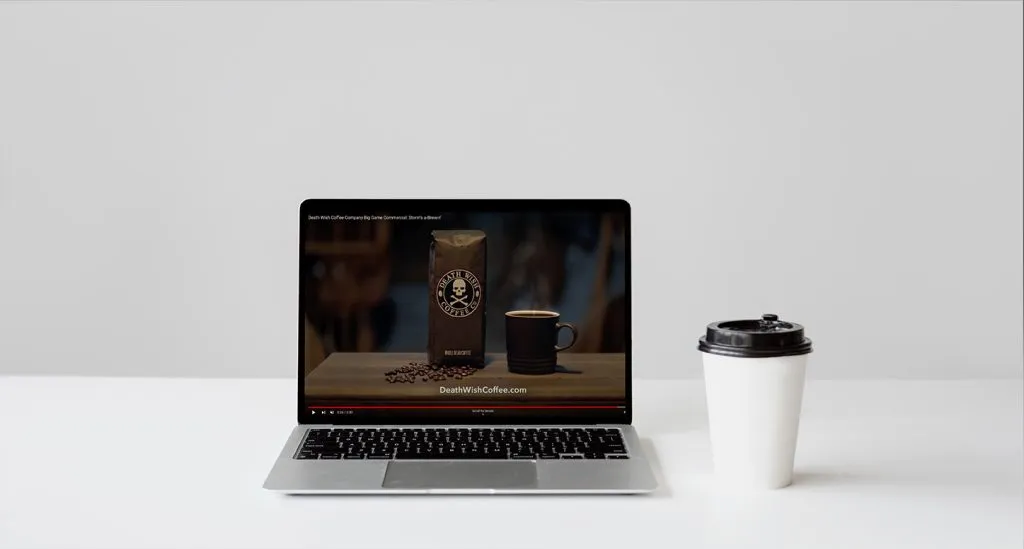
Photo Credit: Intuit Quickbooks Youtube Channel
Back in 2011, at Saratoga Coffee Traders in New York, Mike Brown, the founder, and CEO of Death Wish Coffee, was battling business failure. With competitors like Dunkin Donuts and Starbucks popularizing blonde brews and sugary flavors at the time, it was nearly impossible to find a powerful caffeine buzz. Yet the regulars at Saratoga Coffee Traders were begging for a deadly strong cup of coffee. At this time, Brown had his ah-ha moment — he had to brew the strongest cup of coffee for his customers.
Brown bought Saratoga Coffee Traders in 2008, and the previous owner trained Brown in the shop for 60 days before they finalized the sale. After a few years of keeping the shop afloat, Brown found himself drowning in the coffee rather than serving it.
In an interview with Death Wish Coffee’s Fueled by Death Cast, Brown says, “I think I needed to make like $5,000 a month to make ends meet at the coffee shop.”
Ironically, Brown’s lowest point in business birthed his boldest idea. Brown explains his story in an interview with Forbes.
“Customers would come in and ask for my strongest cup of coffee,” he said. “I wanted to surprise them, so I went online and did some research. I got samples from different importers and made my own blend. So once I had this product that the customers are raving about in my coffee shop, I made this website and made this brand, Death Wish.”
After some time as an e-commerce store, when sales flowed, Death Wish Coffee got the product placement of a lifetime. In 2013, Good Morning America opened the show with Death Wish Coffee, and sales doubled.
It was apparent to Brown that the tables were turning. In 2015, Brown stumbled upon a new opportunity to share his coffee with the world — a Super Bowl XLIX commercial spot fully funded and produced by Intuit Quickbooks.
“I saw an ad for an Intuit QuickBooks Small Business Big Game competition,” he said. “I completed a profile with links to my website and videos of my business. We got our community to vote, and we beat out 15,000 other small businesses.”
The commercial showed a crowded ship of Vikings sailing through a storm. The lead Viking said, “Row, awaken, and welcome death,” as the rushing sea transformed into coffee flowing from a mug to a man’s mouth. At that point in time, Death Wish Coffee was the smallest business the Super Bowl booked a commercial spot for.
“Right as they showed the commercial, there were 100,000 people on the site,” he said. “We had our busiest day of sales ever the day after.”
How Death Wish Coffee Roasted the Competition with Disruptive Marketing
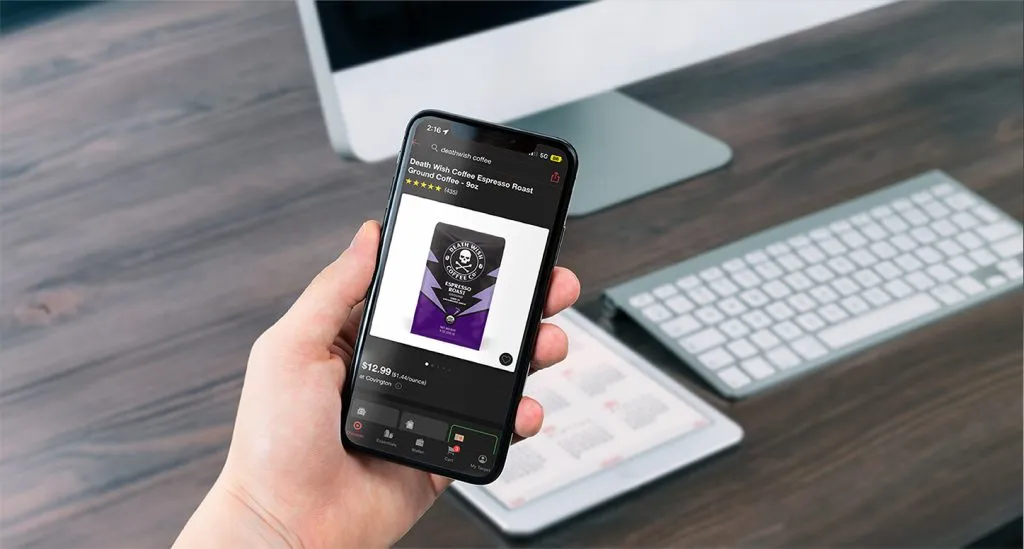
Photo Credit: Target.com
The unconventional concept of Death Wish, alongside a deadly skull and crossbones logo, stands out among large-scale competitors with cheery incentives.
Death Wish Coffee’s website states, “To some, a ‘death wish’ may sound irresponsible, morbid, a step too far — but we believe it’s the boldest sign of living life to the fullest.”
Death Wish Coffee lives its disruptive marketing strategy to the fullest.
Traditionally, disruptive marketing is a strategy in which companies model or re-design their products to please an emerging market or customers looking for something new. At Death Wish Coffee, disruptive marketing looks more like knowing the customer well and giving them precisely what they want. Brown explains to Fueled by Death Cast how the customers rule the roast:
“I put myself in the customer’s shoes all the time, and it’s like, okay, do they love this product because it has that exclusivity factor, or do they love it because it’s a great product? Or do they love it because it’s got a skull and crossbones on it, and it kind of fits in with their identity, and they don’t want anyone else to have it?”
A Cup of Death Wish Coffee with a Splash of Relatable Memes

Photo Credit: @deathwishcoffee Instagram Account
Memes sporting phrases like “Life’s too short to drink sh*t coffee” and “Coffee is just concentrated life force” have been floating across Death Wish Coffee’s social media pages since 2013. Each shows off Death Wish Coffee’s color palette, font, and logo, bringing seamless consistency to its online personality.
In an interview with Medium, Sophia Abbasi, one of Death Wish Coffee’s past social media managers, said, “Our memes are a reflection of ourselves and our community — the sarcastic, cynical coffee-drinking misfits that run on the world’s strongest coffee.”
Now Death Wish Coffee wields its target audience’s passion for strong coffee like a sword, creating humorous memes that relate to their habits. Regardless of how sarcastic or cynical the memes may be, the audience always resonates with and shares them to the point of going viral.
Sipping on Success
The synchronicity of opportunities has guided Death Wish Coffee to reap success. Today Death Wish Coffee is one of the most successful Shopify stores in the United States. The company has sponsored New York Comic Con, Nascar drivers Ty Dillon and Daniel Hemric, and the Special Olympics. In 2018 the Death Wish Coffee team sent freeze-dried Death Wish Coffee into space via NASA Expedition 56.
“Death Wish Coffee’s purpose is fueling other people’s passion — whether it’s motivating them or giving them a great cup of coffee or entertaining them, or just giving them something to look forward to later on in the week,” Brown said. “Thinking about that and how happy it makes others, that gets me up in the morning.”

The Mystique Behind Luxury Fashion Label Fear of God and its Creative Branding
Lorenzo’s fear of god focuses on storytelling, consistent branding, and building a great product
By James Sebastien
Fear of God, an independent American luxury fashion label, sporadically posts on social media these days, despite having over 2 million followers on Instagram. Jerry Lorenzo, who founded Fear of God in 2013, posts more regularly on social media and maintains a similar motif of imagery between his personal and company accounts.
The contemporary apparel company does not market traditionally, pushing user-generated content (UGC) and unboxings aside in favor of exclusivity and intrigue. Fear of God’s brand offers a high-end and sophisticated take on streetwear with oversized silhouettes, neutral color palettes, high-grade materials, and fine craftsmanship.
Fear of God has become popular among magazines, celebrities, and fashion influencers, and the brand has gained a loyal following among fans of high-end streetwear. In addition to its clothing collections, the brand also offers accessories such as shoes, hats, and bags.

Photo Credit: POLA Studio
Building the Fear of God Brand
Lorenzo’s fashion journey began in the stockroom at Diesel while pursuing his MBA at Loyola Marymount in Los Angeles, California. He continued to work in the stockroom for two years. Until one day, he got a shot to work the floor, to which he took advantage by selling over $5,000 of merchandise. The two years he spent working in the stockroom gave him insights into Diesel products and how they are designed to fit, and his knowledge propelled him to success as a salesperson.
However, Lorenzo wasn’t satisfied. He had a vision but not yet to design clothes. His goal was to become a sports agent. He began his career in the marketing department for the Los Angeles Dodgers. He later relocated to Chicago, where he found work at an agency that represented NFL and NBA star athletes.
Ultimately, Lorenzo found himself back in Los Angeles working as a party promoter and began using his initials in his branding, JL Nights. During his parties, he would gather with people who shared his taste in music and fashion. JL Nights grew organically, attracting huge crowds and many celebrities, primarily due to Lorenzo’s attention to detail and focus on creating a great atmosphere.
“The positive skill set was that I built a party that was so good I didn’t have to ask you to come out — you just wanted to be there,” Lorenzo said in an interview with Medium. “With clothing, I don’t ever want to have to promote or ask you to buy something. I want to make something that is so good you just want it. I hated to have to text people to come out to the party, so I did everything I could to make sure we had the best party. My focus has always been on the product.”
Lorenzo began his clothing brand, Fear of God, a name inspired by his religious background, with $14,000 and no prior industry experience. However, he was filled with a burning desire to make a lasting product for himself and his son. As his venture continued, so did his family when he and his wife Desiree welcomed twin daughters. The pressure was on, and the beginning was turbulent at best, but Lorenzo kept on his path.
“I never lost the conviction that I knew I had something to say or offer,” he said.
Lorenzo thinks of himself as a storyteller and creates a story around his product that consumers can, hopefully, understand.
“It’s a story of American expression,” he said in an interview with the New York Times. “My influences are wide-ranging, from ‘90s hip-hop to Tom Cruise in ‘Risky Business.’ The proposition with American luxury is that you are given the freedom to express yourself and to be whatever you want. I give my customers encouragement to follow their instincts, always to be comfortable, appropriate, elegant no matter what they do.”

Photo Credit: POLA Studio
Finding Support and Success
In the weeks following the drop of Fear of God’s first collection, the late Virgil Abloh, a former Chicago acquaintance, fashion designer, and creative director of men’s wear for Louis Vuitton, took note and reached out to Lorenzo. Abloh invited Lorenzo to Atlantic City to showcase his collection to none other than Kanye West. Lorenzo and West went on to collaborate on several projects.
In Lorenzo’s words, the next three years were a whirlwind and challenging, but with West’s approval, he found greater faith in himself and his brand. Lorenzo and West eventually ended their partnership, and Fear of God continued to collaborate with celebrities like Justin Bieber and brands like Nike, New Era, and Adidas.
Lorenzo expanded Fear of God beyond his men’s line to include a women’s line inspired by his daughters. Fear of God also has subdivisions, including Essentials and the soon-to-be-released Athletics. Whenever Lorenzo drops a new collection, items almost instantaneously sell out.
The renowned designer continues to operate the privately-held luxury label with his unique business model, constantly innovating and developing the Fear of God brand while refusing to play by the rules or participate in fashion week.
Fear of God’s Marketing Strategies
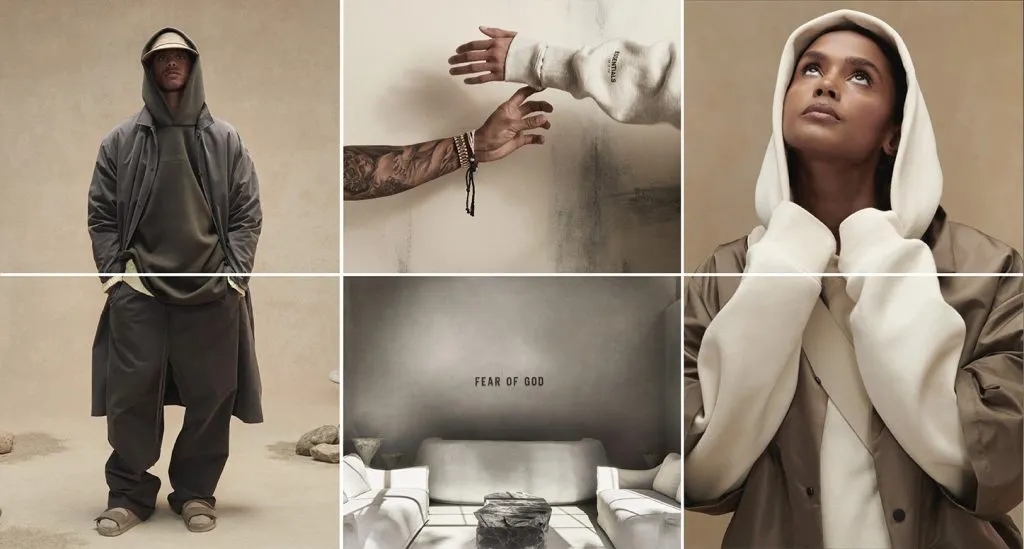
Photo Credit: POLA Studio
With a background in marketing, one would think that Lorenzo’s approach to promoting Fear of God would be more traditional. Instead, the label’s marketing reflects his unorthodox views of fashion and branding. Fear of God often uses neutral, moody, and minimalistic imagery that is desaturated with a slight film grain to appeal to younger demographics.
The luxury streetwear label’s target audiences span across the Millennial and Gen Z populations providing them a glimpse into celebrity lifestyle at astonishing costs. However, Fear of God’s Essentials line allows fans of the brand to purchase items at a far more affordable price.
Lorenzo uses his personal, Fear of God, and Essentials Instagram accounts to market to his massive following, from events featuring Fear of God, like the Chris Rock and Dave Chappelle stand-up tour, to new collection drops. Instagram posts act almost as press releases for Lorenzo and his company, as reporters for online publications latch on to his feeds, releasing the latest drop news mere moments following notification alerts appearing across their phones.
Lorenzo defies the traditional way fashion labels are supposed to market with his direct-to-consumer e-commerce strategy, which fits into younger audiences’ preferred comfort level of purchasing products straight from companies. In addition to buying directly from Fear of God, consumers can purchase items from the label through SSence and Mr Porter.
The most effective marketing tools at Fear of God’s disposal are Lorenzo himself and his celebrity friends, who all act as living, breathing ads for the luxury fashion label and its subdivisions.
Lorenzo has no partners or investors, so he can market the label as he sees it and strategize with his team for each collection drop without worrying about a clear and direct vision for the future. Yet, despite the lack of a big-picture goal, Lorenzo and his Fear of God never cease to amaze their loyal consumers who fringe on cult status.
What’s next for the label? By best guess, not even Lorenzo knows for sure.
Fishwife is making Tinned Fish and Seafood Stylish with its Distinctive Branding
How fishwife used quirky illustrated art and honest branding to become the biggest catch in the tinned fish market
The bold colorways and intricate illustrations of Fishwife’s distinct packaging designs are alluring enough to hook people while browsing the sterile tinned-fish isle. A brash and illustrious namesake makes people wonder. Finally, the sustainable mission and product quality reels them in.
Fishwife, a Los Angeles-based direct-to-consumer (DTC) company, puts a colorful spin on high-quality tinned fish while preserving ethics and sustainability with utter ease. For traceability, the company shares partnerships with small canneries in Spain, Washington State, and British Columbia and responsible fisheries and aquaculture farms across the globe. The company’s efforts help maintain the quality of its crowd-favorite products like smoked Atlantic salmon, rainbow trout, and wild-caught smoked albacore tuna.
Although eating tinned fish has always been wildly popular in Portugal and Spain, after the canned tuna fad of the 1930s, people in the United States are still warming up to the delicacy anew. Fishwife’s mastery of changing the narrative of tinned fish from cheap and easy to healthy and elegant, yet accessible, has garnered interest from many corners of the internet. A few months after its launch in 2020, publications like the New York Times, Forbes, and Bon Appétit Magazine reached out to Fishwife for features. The brand has attracted over sixty thousand tinned fish lovers on social media.
Birthing a Company the World is Hungry For
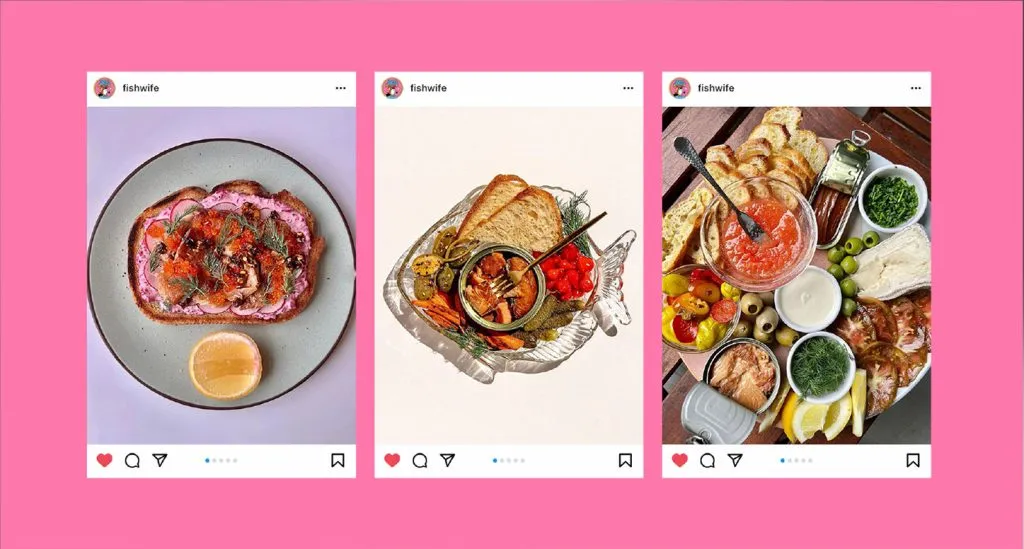
Photo Credit: @fishwife Instagram Account
One doesn’t simply wake up one day and decide to start a tinned-fish company, let alone the most popular tinned-fish brand in the United States. For Becca Millstein, the founder and CEO of Fishwife, inspiration came from her travels, and action came from quarantine.
In an interview with Artful Living, Millstein explains, “I discovered the elegance and beauty of tinned fish when I was living in Spain during college.” She said, “I fell in love with the simplicity of tinned sardines with a crusty baguette and a glass of wine.”
Millstein’s discovery would remain on the back burner for quite some time before evolving into Fishwife. After graduating from Brown University, she moved to Los Angeles to pursue a career in music brand partnerships at a talent agency.
Although she found her role in the music industry fascinating, it lost its dazzle after a few years. Millstein was on her own ventures with smaller private labels when the pandemic struck in 2020. Like many others, her career trajectory changed. Millstein explains Fishwife’s story to Acid League during an interview.
She said, “The idea for the company came when me and my friend Caroline were quarantining together. We were eating so much tinned fish during quarantine — because it’s shelf-stable, it’s healthy, it’s delicious. Caroline and I saw that many of our peers had had similar experiences with tinned seafood and realized that no domestic brand was speaking to our demographic. So we decided to make it happen.”
Millstein’s mission to make ethically sourced, premium, and delicious tinned seafood a staple in every cupboard was obvious. Looking back on formulating her business in an interview with Eater, she said, “Everything was a challenge — and that was the fun part.” Aside from the marketing aspects of building a formalized company, everything was new to Millstein. From sourcing fish and building supply chains to establishing fulfillment partners, Millstein had much to learn, build, and sustain.
“As one of only a few full-time employees at Fishwife, my job involves every task that needs to be completed at an early-stage food CPG [consumer packaged goods] startup,” she said. “That includes supply chain, marketing, partnerships, collaborations, product development, fundraising, team management, and more.”
One thing remained constant through all the new responsibilities and struggles of launching a DTC brand — Millstein’s dedication to building an iconic yet dependable company.
How Becca Millstein Made Ethical Tinned Fish Cool
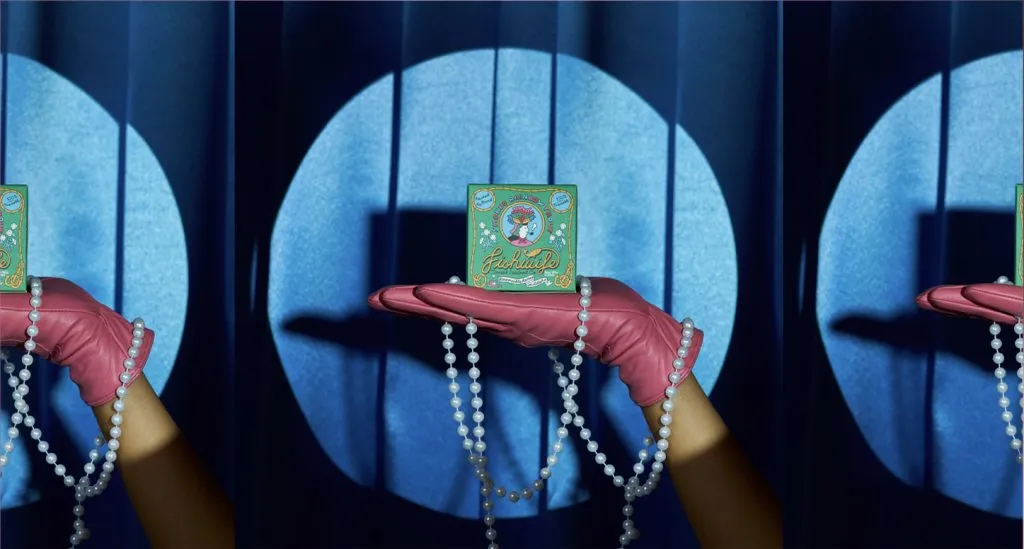
Photo Credit: POLA Studio
Combined with luxurious and tasty products, each component of Fishwife’s branding makes it a hot commodity and a brand with everlasting success. In a market consumed by bland corporation-owned tuna fish, a bold brand identity paired with eccentric packaging took Fishwife from the sea to the stars.
Although building a CPG startup was uncharted waters for Millstein, branding wasn’t. On Fishwife’s website, the humorous copywriting, themed illustrations, and cheery colors draw the eye. It is abundantly clear that Millstein is the branding mastermind hidden beneath the tedious business operations.
“Creating the name, the brand identity, and the visual of the brand, was really natural for me, and very easy, and very, very fun,” she said.
Upon some digging on the company’s story website page, consumers are introduced to Fishwife’s witty personality. The satirical namesake comes from the 16th-century term for women related to fishermen. According to Fishwife’s website, “The term gradually evolved into a gendered insult for women who were brash, foul-mouthed, and brassy. We relate.”
Fishwife’s visual branding pays homage to its quick-witted brand voice thanks to artist Danny Miller. He alchemizes Fishwife’s mission and brand personality into lively characters, primary color palettes, and quirky graphics that adorn the product packaging, websites, and social media pages.
Millstein explained to Acid League, “Miller is my closest creative collaborator,” she said. “He had never done any sort of brand or packaging work before, but his style just was so clearly aligned with what we were trying to communicate.”
Turning Branded Artwork into a Marketing Strategy
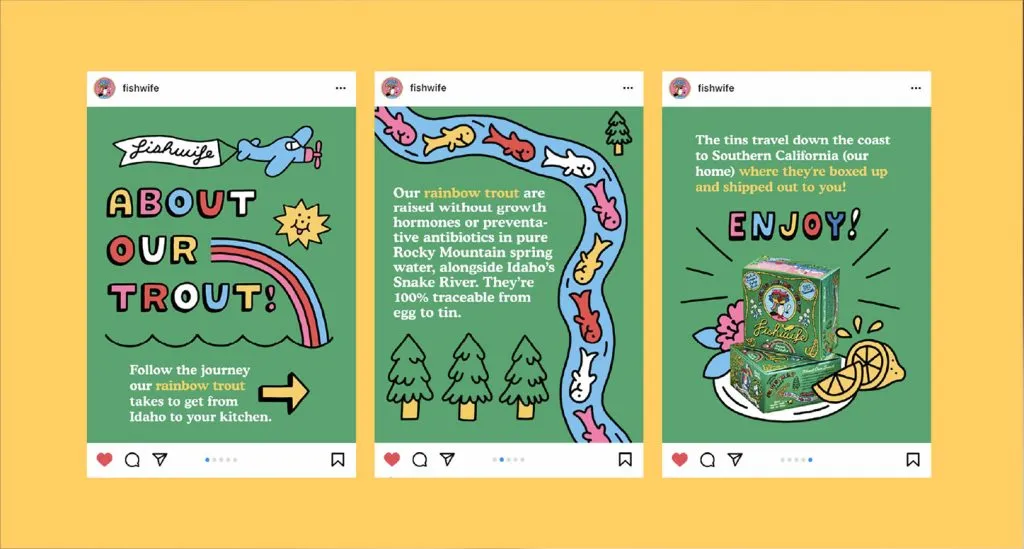
Photo Credit: @fishwife Instagram Account
Fishwife launched in August 2020 with bold branding and aptitude to draw attention. No one, not even Millstein, could have predicted the considerable effect of attractive branding on Fishwife’s success. It became clear to Millstein that people were intrigued by a tinned-fish brand with an eye for illustrated artwork.
“We approach packaging by just creating the most beautiful work of art we can,” she said.
Seeing the commotion caused by its logo and visual branding, Fishwife continued making art a central marketing strategy. By sharing other artists’ work inspired by Fishwife, the brand has built up a niche community passionate about art and conservas.
“From day one, we were a very art-forward brand, so a lot of artists came to us to collaborate, and then we’ve just kept doing it, and it’s really, really fun,” she said. “And it’s fun to have a legion of artist customers because they’re just really fun advocates for the brand.”
With a community of art enthusiasts came a strategy that many DTC brands are adopting — designing brand merchandise that people will actually want to wear. Fishwife dropped its first round of merchandise in June 2021. The drop included a tee shirt and a tote bag that states, “Hot girls eat tinned fish,” with an illustration of a mermaid eating Fishwife canned seafood. In addition to consistent merchandise sell-outs, the phrase began to go viral on Instagram and TikTok, generating even more fans for Fishwife.
Fishwife continues to create merchandise for its fans. Some of its most recent additions include zippered pouches, baseball caps, and beanies. The brand even partnered with ceramicist Dominique Ostuni to produce a limited quantity of Fishwife-inspired ceramic mugs.